
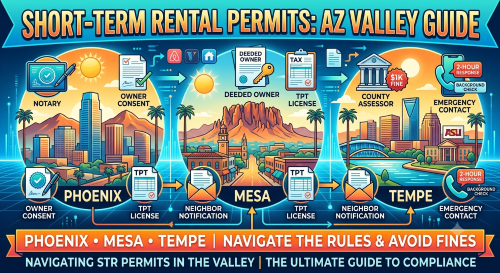
The short-term rental market across the Valley of the Sun is booming, but navigating the legal landscape can feel like a maze. If you think securing a permit in Phoenix means you are automatically ready to roll in Mesa or Tempe, think again. Even though these cities sit right next to each other in Maricopa County, their local governments view short-term rental (STR) regulations quite differently.
Operating without a valid permit is a massive financial gamble. Cities have aggressively ramped up enforcement, and illegal hosting can easily trigger crippling fines of $1,000 or more per month. Fortunately, the actual permit fees remain incredibly cheap, usually $250 or less. Investing a little time and a couple of hundred bucks will shield your business from devastating penalties.
While every city demands its own specific paperwork, the application processes share a few common threads alongside their glaring differences. Let’s break down exactly how Phoenix, Mesa, and Tempe stack up so you can keep your rental business fully compliant.
The Common Ground: What Every Valley City Demands
Before diving into the unique quirks of each municipality, you need to understand the baseline requirements. Arizona state law sets certain boundaries, meaning you will face a few identical hurdles no matter where your property sits.
- The TPT License: First and foremost, the Arizona Department of Revenue requires a Transaction Privilege Tax (TPT) license. This license allows you to collect and remit lodging taxes. You cannot bypass this step, as every single city requires a valid TPT number on your application.
- Neighbor Notifications: Secondly, all three cities champion neighborhood transparency. You must notify all adjacent neighbors—and often those directly across the street or behind your property—that you are operating an STR. You must send these notifications and provide the neighbors with emergency contact information.
- Proof of Compliance: Finally, you cannot just promise that you mailed the letters. You must submit physical or digital proof of the neighbor notification directly to the city before they will approve your permit.
Phoenix: The Paperwork and Notary Heavyweight
If your property holds a Phoenix address, prepare yourself for a rigorous verification process. Phoenix focuses heavily on accountability and wants explicit proof that the property owner approves of the short-term rental operation. This requirement impacts rental arbitrageurs, people who lease a property to re-rent it on Airbnb—much more than traditional property owners.
The Owner Consent Hurdle
Unlike its neighbors, Phoenix demands a signed document from the property owner that explicitly grants permission to run a short-term rental on the premises. If you do not own the deed to the house, you cannot simply upload a standard lease agreement. You must get the owner’s official rubber stamp.
The Online Notary Requirement
To make things even more intense, Phoenix requires this owner signature to be notarized. Fortunately, modern technology saves the day here. You can easily utilize online notary services to verify the signatures digitally, saving you a trip to a physical bank or shipping store. Once you secure the notarized consent, you can upload it to the city’s licensing portal along with your $250 fee.
Mesa: The Deeded Owner Portal Route
Just a short drive east into Mesa, the rules change completely. Mesa shifts its focus away from upfront notarized tenant-owner consent and instead relies on strict portal validation via their online application system, DIMES.
The Deeded Owner Requirement
Mesa addresses accountability by restricting the permit process entirely to the property owner. The city will only issue short-term rental licenses directly to the deeded owner of the unit rather than to property managers or third-party representatives.
Insurance and TPT Verification
During the online process, Mesa requires clear proof of insurance. You must show that your policy specifically covers short-term rental activities with a minimum of $500,000 in liability coverage. You will also need to plug in your TPT license during the digital application process.
The Sneaky Owner Notification Trap
Because Mesa requires the deeded owner to hold the license, it assumes the owner is fully aware. However, if you are attempting to partner on a property or lease option, the city does not force you to upload an owner’s signature like Phoenix does. It simply requires notification. But beware: if you trigger notifications or try to set up an STR without having the owner sign a Letter of Intent (LOI) beforehand, you will likely violate your underlying lease and face immediate eviction. Always secure an LOI privately first.
Tempe: The High-Tech and Strict Nuisance Control
Tempe takes a highly structured approach to short-term rentals. Because the city deals with a dense population and a vibrant student scene, its regulations focus heavily on maintaining neighborhood peace, safety, and strict county alignment.
The Mandatory County Assessor Link
Here is where Tempe stands out: the city explicitly requires proof that you have registered the rental property with the Maricopa County Assessor’s Office. If you fail to register the property with the county before applying for your Tempe STR license, the city’s code enforcement unit can slap you with an immediate $1,000 fine.
The 24/7 Emergency Contact & Background Checks
Tempe emphasizes responsiveness above all else. During the application process, you must designate a local emergency contact person who can respond to the property within two hours of a complaint. Additionally, Tempe implements unique safety protocols, requiring sex offender background checks on all registered emergency contacts and property managers associated with the STR permit.
The Ultimate Comparison: Phoenix vs. Mesa vs. Tempe
To help you visualize these differences, look at how the core requirements shake out across the three cities:
| Requirement | Phoenix | Mesa | Tempe |
| Permit Cost | $250 or less | $250 or less | $250 or less |
| Owner Signature Required? | Yes, Notarized | No, must be deeded owner | No, but lease proof may be asked |
| County Assessor Registration? | Optional during city application | State requirement, but not verified on portal | Mandatory on application ($1k fine if missed) |
| Neighbor Notifications? | Mandatory | Mandatory | Mandatory |
| Local Contact Response Rule? | Standard | Strict 1-Hour Window | Strict 2-Hour Window |
Protect Your Investment: Why Compliance Matters
Ultimately, navigating these varying municipal codes requires diligence, patience, and attention to detail. Moving from Phoenix to Mesa to Tempe means changing your regulatory strategy every time you cross city lines.
Never try to fly under the radar to save a quick buck. Code enforcement officers actively scrape platforms like Airbnb and Vrbo to match listings against their permit databases. Spending $250 upfront guarantees peace of mind and protects your business from the catastrophic $1,000+ monthly fines that cities hand out to illegal operators. Learn the specific rules for your city, gather your paperwork, and launch your rental the right way.
Leave a Reply