
Unlocking the High Cost of Non-Compliance: Fines for Illegal Short-Term Rentals in Mesa, Tempe, and Scottsdale
Arizona’s East Valley continues to attract millions of tourists annually, creating a lucrative market for short-term rental (STR) hosts. However, municipal authorities across Maricopa County have transformed the local regulatory landscape. Cities like Mesa, Tempe, and Scottsdale now enforce strict licensing laws and aggressive fine structures to curb unlicensed operators, party houses, and neighborhood disturbances. Operating an unpermitted Airbnb or Vrbo property no longer carries a minor risk; instead, it exposes property owners to devastating financial penalties and legal action. Understanding the financial penalties across these three cities helps hosts protect their investments and maintain legal compliance. Below, we break down the exact fines, legal frameworks, and enforcement mechanisms governing illegal short-term rentals in Mesa, Tempe, and Scottsdale.
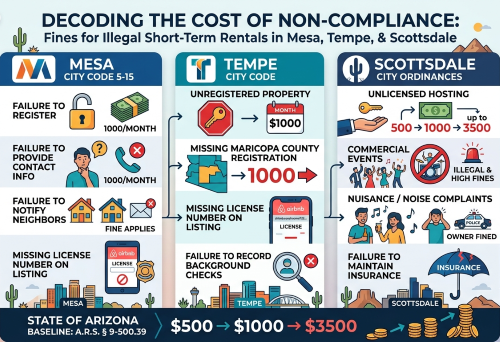
The Arizona State Baseline: A.R.S. § 9-500.39
Before examining specific city codes, real estate operators must understand state-level enforcement boundaries. Under Arizona Revised Statutes (A.R.S.) § 9-500.39, state lawmakers granted cities explicit authority to penalize non-compliant vacation rentals through structured civil penalties.
- First Verified Violation: Municipalities charge up to $500 or an amount equal to one night’s advertised rental rate, whichever amount is greater.
- Second Verified Violation: Local courts assess penalties up to $1,000 or two nights’ advertised rent, whichever amount is greater, for a secondary infraction within a twelve-month period.
- Third and Subsequent Violations: Authorities levy heavy fines up to $3,500 or three nights’ advertised rent, whichever amount is higher, for recurring infractions.
Consequently, hosts who repeatedly violate local rules face exponential cost increases. Furthermore, state law empowers municipalities to suspend an owner’s operating permit for up to twelve months following three verified violations within a single year.
Mesa: Regulations Under City Code 5-15
Mesa City Council officially enacted Mesa City Code 5-15 to curb nuisance properties and ensure neighborhood safety. Indeed, Mesa requires every short-term rental operator to secure a $250 annual license before publishing any online listing.
Fines for Unlicensed Operations
Operating an unlicensed vacation rental in Mesa triggers immediate administrative action. Specifically, city auditors track online booking portals to identify unregistered properties.
- Failure to Register: The city assesses civil penalties of up to $1,000 per month against owners who operate or advertise without obtaining a valid Mesa STR license.
- Failure to Provide Contact Information: Mesa imposes an additional civil penalty of up to $1,000 every thirty days if an owner fails to submit required 24/7 emergency contact details.
- Failure to Notify Neighbors: Neighbor notification remains a mandatory legal requirement under MCC 5-15-4. Failure to provide written notice to adjacent property owners yields immediate municipal code violation notices.
Moreover, Mesa requires hosts to display both their local license number and their Arizona Transaction Privilege Tax (TPT) permit on every public listing. Neglecting to list these registration numbers results in swift listing suspensions and formal citations.
Tempe: Monthly Penalties and Strict County Mandates
Tempe enforces some of the most rigorous short-term rental compliance monitoring programs in the State of Arizona. Consequently, property owners in Tempe face swift monetary sanctions if they attempt to bypass licensing protocols.
Licensing and County Assessor Violations
Tempe charges an annual $250 licensing fee per unit, but the costs of skipping this step remain extraordinarily high.
- Unregistered Property Fine: Tempe Code Enforcement levies an immediate penalty of up to $1,000 per month against owners who list or rent properties prior to receiving official license approval.
- Maricopa County Assessor Fine: Tempe strictly enforces Maricopa County rental registration requirements. If an owner fails to register their property with the county assessor, the city issues a direct $1,000 fine.
- Retrospective Revenue Penalties: Using advanced software tracking tools, city officials calculate past booking activity. Subsequently, Tempe retroactively taxes and penalizes illegal hosts based on historical earnings generated during period of non-compliance.
Additionally, Tempe requires hosts to perform background checks on primary bookers through the Department of Justice Sex Offender Registry. Hosts who fail to keep verified records of these checks risk immediate civil citations and potential license revocation.
Scottsdale: Heavy Enforcement and Commercial Event Bans
Scottsdale represents one of the nation’s premier vacation markets, yet city officials actively combat nuisance rentals through Ordinance 4566 and Ordinance 4719. Because party houses disrupt residential neighborhoods, Scottsdale maintains aggressive inspection teams to fine non-compliant operators.
Specific Violations and Escalating Penalties
Scottsdale mandates that every property operating as a stay under 30 days must hold a valid municipal permit.
- Unlicensed Hosting: The city levies a $500 penalty for a first offense, which quickly escalates to $1,000 for a second offense and $2,000 to $3,500 for subsequent infractions.
- Commercial Event Violations: Ordinance 4719 strictly prohibits hosts from converting residential STRs into commercial event spaces. Promoters or owners hosting unauthorized weddings, corporate functions, or large paid parties face immediate law enforcement intervention, thousands of dollars in civil fines, and judicial license suspensions.
- Nuisance and Noise Complaints: Police officers respond directly to noise and parking complaints at vacation rentals. Besides issuing citations to disruptive guests, the city penalizes property owners directly for repeated neighborhood disturbances.
Furthermore, Scottsdale requires hosts to maintain at least $500,000 in liability insurance coverage. Operating without proper liability insurance constitutes an immediate ground for license denial or emergency suspension.
Secondary Financial Fallout Beyond City Fines
While municipal fines cost owners thousands of dollars, illegal hosting triggers secondary financial liabilities that often dwarf basic administrative penalties.
| Penalty Category | Authority | Potential Financial Impact |
| Unpaid TPT Taxes | Arizona Dept. of Revenue | Back taxes + interest + unpaid tax penalties |
| Platform Removal | Airbnb / Vrbo / Booking.com | Permanent ban and loss of future booking revenue |
| Insurance Claim Denials | Private Insurers | Complete loss of coverage for property damage or injuries |
| HOA Violations | Homeowners Associations | Additional civil fines up to thousands of dollars |
For instance, the Arizona Department of Revenue actively audits STR tax filings. Failing to remit state and local transient lodging taxes leads to severe tax evasion penalties, state audits, and mandatory interest payments. Simultaneously, platforms like Airbnb automatically remove listings that fail to show verified city license numbers.
Steps to Achieve 100% Compliance
Avoiding destructive fines requires a proactive compliance strategy across all three East Valley jurisdictions.
- Obtain an Arizona TPT License: Register your business with the Arizona Department of Revenue to collect state and local lodging taxes.
- Register with Maricopa County: List your property on the Maricopa County Assessor’s residential rental portal.
- Apply for Local Licenses: Complete the specific online licensing application for Mesa, Tempe, or Scottsdale before creating public listings.
- Notify Surrounding Neighbors: Mail or hand-deliver required notification letters containing your 24/7 emergency contact details to adjacent property owners.
- Display License Numbers: Clearly post your local municipal license number and state TPT permit on all digital advertisement channels.
Ultimately, running an illegal short-term rental in Mesa, Tempe, or Scottsdale is a losing financial strategy. By securing proper permits, maintaining adequate liability insurance, and respecting community standards, hosts can build sustainable, highly profitable vacation rental businesses in Arizona.
Leave a Reply