
STR Arbitrage vs. Property Ownership: The Ultimate Guide
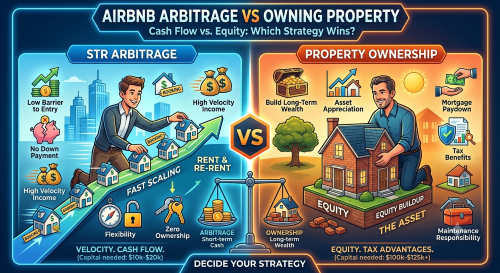
The debate between short-term rental (STR) arbitrage and traditional property ownership comes down to one core tradeoff: velocity vs. equity. STR arbitrage, where you lease a property long-term and re-rent it on platforms like Airbnb or VRBO, lets you scale a hospitality business fast with minimal capital. Conversely, owning the real estate builds long-term wealth, equity, and tax advantages. While both models generate cash flow, they operate on completely different risk profiles and timelines. Here is how they stack up.
What is STR Arbitrage?
Essentially, arbitrage means taking advantage of a price difference between two markets. In real estate, this involves signing a standard long-term lease with a landlord, including a written corporate lease addendum allowing subleasing, and then furnishing the property to list on short-term platforms. After paying a fixed monthly rent to the owner, you keep whatever profit remains once utilities, cleaning, software, and platform fees are covered.
The Pros of STR Arbitrage
1. Low Barrier to Entry
Buying a $500,000 investment property usually requires a 20% to 25% down payment ($100,000 to $125,000), plus closing costs and reserves. In contrast, your upfront capital stays remarkably low with arbitrage:
- First month’s rent and security deposit
- Furnishing and staging costs ($5,000 to $15,000 depending on property size)
- Initial setup, professional photos, and supplies
Ultimately, you can launch a cash-flowing unit for $10,000 to $20,000 instead of six figures.
2. Rapid Scalability
Because each unit requires significantly less capital, scaling happens much faster. For instance, reinvesting cash flow from your first arbitrage unit allows you to secure a second lease within six months rather than waiting years to save another massive down payment.
3. Maximum Flexibility and Low Risk of Entanglement
Furthermore, you do not own the dirt. If local market regulations shift, neighborhood demand drops, or HOA rules change, you are not trapped. Instead, you simply wait out your lease term or negotiate an exit and walk away.
4. Zero Maintenance Costs
When the roof leaks, the HVAC unit dies, or a pipe bursts, the property owner pays for repairs. As an arbitrage operator, your financial responsibility stops at minor tenant-caused damages, which guest insurance (like Airbnb AirCover) usually handles anyway.
The Cons of STR Arbitrage
1. No Equity or Asset Appreciation
However, you build zero long-term wealth in this model. When handing the keys back to the landlord at the end of the contract, you retain no asset, no equity, and no lingering cash flow. Thus, you trade your time and capital purely for active short-term income.
2. Landlord and Lease Risk
Additionally, your business model relies entirely on third-party permission. Landlords can choose not to renew your lease, increase rent beyond profitability, or sell the property out from under you. Consequently, you are constantly building a business on leased land.
3. Fixed Overhead Liability
During slow seasons, market downturns, or global disruptions, your lease payment remains strictly due on the first of the month. If booking revenues plummet, you must cover rent and utility bills out of pocket regardless.
The Pros of Owning Short-Term Rentals
1. Multi-Pronged Wealth Creation
On the flip side, owning the underlying real estate offers four distinct revenue channels:
- Cash flow: Profit remaining after mortgage, expenses, and operational costs.
- Appreciation: Property value increases over time.
- Debt paydown: Guests effectively pay off your principal mortgage balance every month.
- Tax benefits: Depreciation, cost segregation studies, and 1031 exchanges can dramatically reduce overall tax burdens.
2. Complete Operational Control
Because you own the property, you make every design modification, add value-add amenities (like hot tubs or game rooms), and pivot your strategy whenever you want. As a result, you never have to ask permission from a landlord.
3. Permanent Exit Strategies
If short-term rental bans pass in your city, an owner can easily pivot by:
- Converting to a long-term rental
- Transitioning to medium-term/corporate travel housing
- Selling the property and capturing accumulated market equity
The Cons of Owning Short-Term Rentals
1. Heavy Capital Requirements
On the downside, saving money for a down payment takes significant time. This slow pace of acquiring capital inherently limits how quickly you can scale an ownership portfolio without taking on expensive equity partners or hard money lenders.
2. Full Maintenance and Capital Expenditure Liabilities
Moreover, capital expenditures (CapEx) sit entirely on your shoulders. A broken furnace or damaged roof eats directly into your bottom line, and unexpected structural repairs can eliminate an entire year of cash flow instantly.
3. Illiquidity
Finally, real estate is slow to liquidate. If you need cash quickly, selling a property takes months and costs roughly 6% to 10% of the sale price in transaction fees and agent commissions.
Side-by-Side Comparison
| Feature | STR Arbitrage | Property Ownership |
| Upfront Capital | Low ($10k – $20k) | High ($50k – $150k+) |
| Scaling Speed | Fast | Slow to Moderate |
| Asset Equity | None | High (Grows over time) |
| Tax Advantages | Standard business expenses | Depreciation, Cost Segregation, 1031s |
| Maintenance Burden | Minor / Operational | Full CapEx Responsibility |
| Exit Flexibility | Walk away at lease end | Sell property, pivot rental strategy |
Which Model Fits Your Strategy?
Choose STR Arbitrage if:
- You have limited capital but strong operational skills.
- Building active monthly cash flow rapidly is your primary goal.
- Testing specific markets without long-term financial commitments appeals to you.
Choose Property Ownership if:
- You already possess significant capital or equity.
- Your main focus centers on long-term wealth creation and tax mitigation.
- Holding tangible assets feels preferable to running a high-volume leasing model.
Ultimately, many successful investors combine both strategies by using cash flow generated from high-yield arbitrage units to fund down payments on properties they eventually own outright.
Leave a Reply